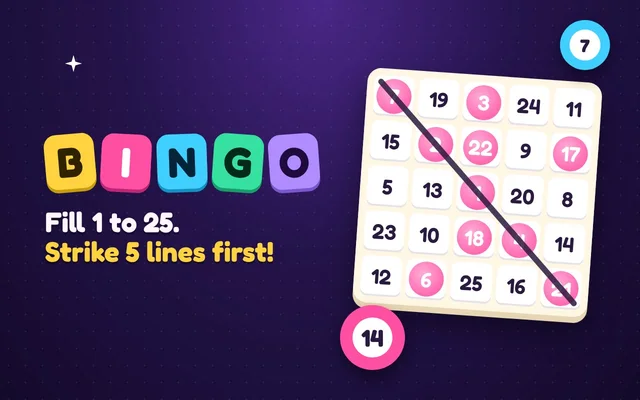
Bingo 1 to 25 Strategy: 7 Tricks to Get 5 Lines Faster
Why the diagonals matter most, the 16-number minimum, and which number to call on your turn. Simple, tested tricks to win more games of 1-25 bingo.
By Tikogames team · · 4 min read
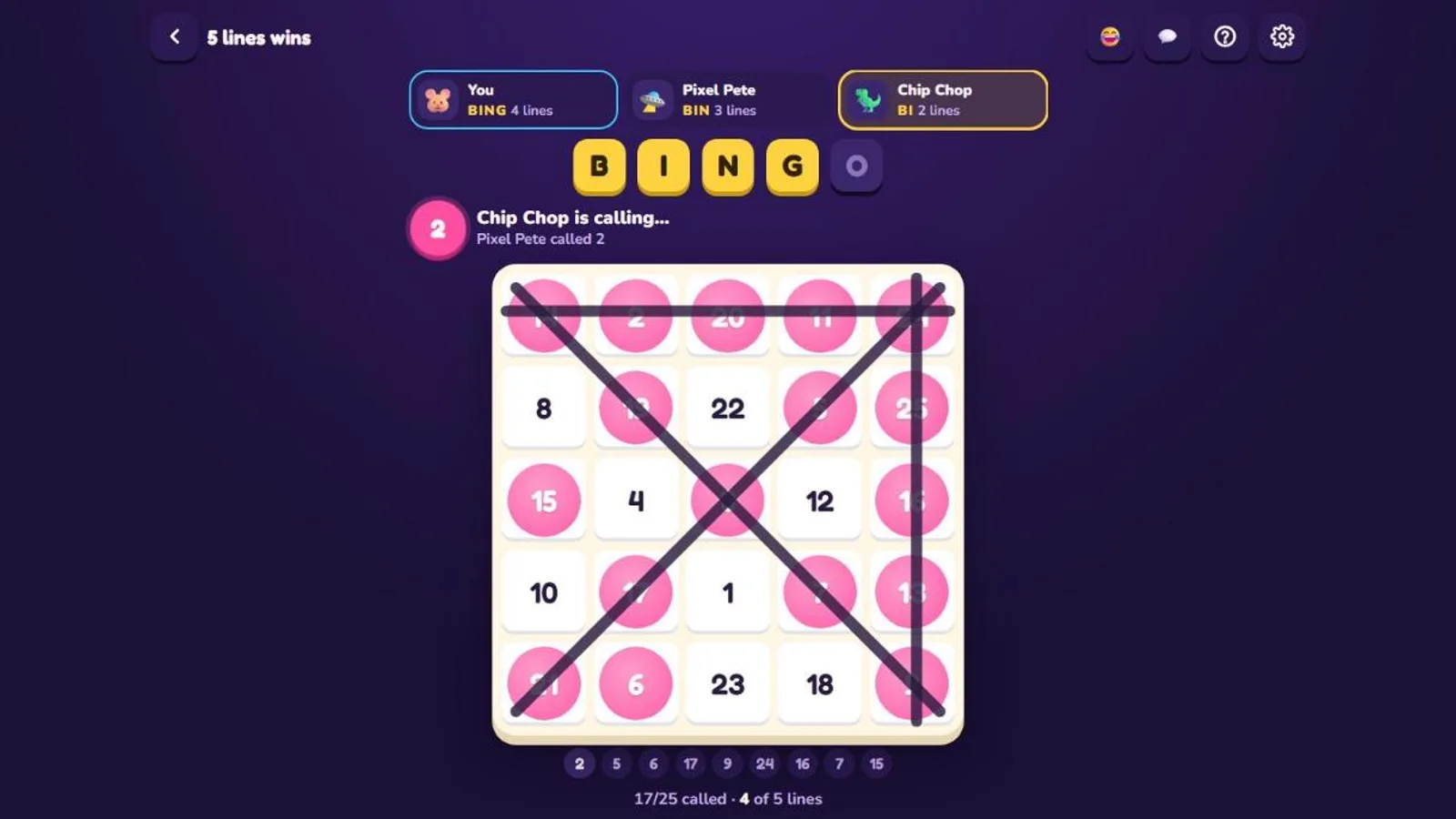
In Bingo 1 to 25 you pick every number you call, so it isn't pure luck. A few simple habits make a real difference to how often you shout BINGO first. These tricks come from counting every possible way to finish five lines on a 5×5 grid, not from guesswork.
New to the game? Each player fills a 5×5 grid with 1 to 25, players take turns calling numbers, and the first to cross off five full lines wins. You can learn it in one round of Bingo 1-25.
1. Know the magic number: 16
A 5×5 grid has 12 lines: 5 rows, 5 columns and 2 diagonals. We checked every combination of five lines, and the smallest number of crossed boxes that completes five of them is 16. You can't win in fewer, whoever calls the numbers.
So if you've crossed 16 numbers and have only two lines, your crossed boxes are spread too thin. The tricks below are all about wasting as few boxes as possible.
For the quicker 3-lines game, the minimum is 12 crossed numbers.
2. Always go for both diagonals
There are only eight ways to get five lines with just 16 numbers, and every one of them uses both diagonals. The diagonals cross each other in the centre and also cross every row and column, so each diagonal box does double or triple duty.
How much each box is worth:
- The centre box sits on 4 lines (its row, its column and both diagonals).
- The other 8 diagonal boxes sit on 3 lines each.
- Every other box sits on just 2 lines.
When you're choosing what to call, a number on a diagonal is usually worth more than one that isn't.
3. Build the "X plus three" shape
All eight fastest patterns look the same: the two diagonals (an X), plus three more lines chosen from the outer and second rows and columns. A typical one is the X plus the top row, the bottom row and the second column.
None of the fastest patterns use the middle row or the middle column. Their centre box is already crossed by the X, so they add 4 new boxes, while an outer line adds only 3 new boxes because its corners are already on the X. Plan for edge lines once your X is going.
4. Call the number that finishes a line soonest
On your turn, look for the line that is closest to done:
- If any line has 4 of 5 crossed, call the missing number. A finished line now beats a better shape later.
- Otherwise, call a number that moves two or more of your lines forward at once, ideally a diagonal box.
- If everything is equal, call a number on the line that other players' calls have been helping most.