Tic Tac Toe strategy: how to never lose, going first or second
Perfect Tic Tac Toe always ends in a draw, so the real goal is never losing and catching opponents who slip. Here's the strategy for going first, going second, spotting forks and blocking them.
By Tikogames team · · 5 min read
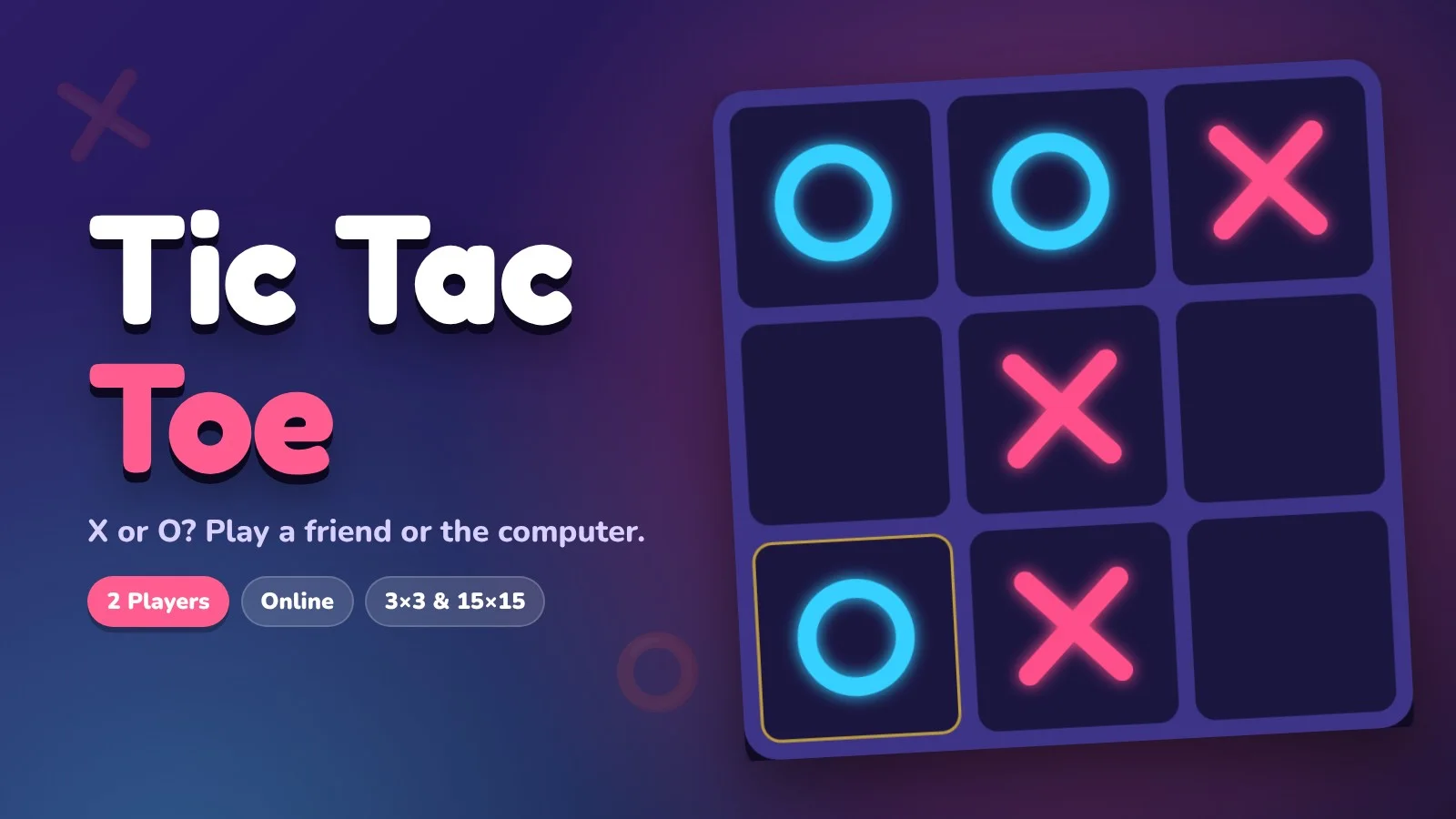
You can't always win Tic Tac Toe, but you can make sure you never lose. If both players make the best moves, every game ends in a draw. So the strategy has two parts: play the safe replies so nobody can trap you, and set traps of your own so a weaker opponent makes the one mistake that loses.
The secret behind almost every win is the fork: a move that makes two threats at once. Your opponent can only block one. This guide shows how to make forks when you go first, and how to stop them when you go second.
When we built the computer player for our Tic Tac Toe, we gave the Hard level perfect play on the 3×3 board. It never loses, so the best anyone can do against it is a draw. That made it a handy way to test the advice below.
Tic Tac Toe rules (and rules for kids)
- Two players take turns on a 3×3 grid. One plays X, the other O.
- X usually goes first.
- On your turn, put your mark in any empty square.
- Get three of your marks in a row (across, down or diagonally) and you win.
- If all nine squares fill up with no row of three, it's a draw.
For kids, that's all there is. A nice tip for young players: before each move, ask two questions. "Can I win right now?" and "Is my friend about to win?" Those two checks alone stop most losses.

Naming the squares
To keep the strategy simple, we'll use three names:
- Centre: the middle square.
- Corners: the four corner squares.
- Edges: the four middle squares on the sides.
The order to check on every move
Strong players run through the same checklist every turn:
- Win. If you have two in a row with the third square empty, take it.
- Block. If your opponent has two in a row, block the third square.
- Fork. Make a move that creates two threats at once.
- Block a fork. If your opponent could fork next turn, stop it, ideally by making a threat of your own that forces them to answer.
- Otherwise: centre, then a corner, then an edge.
Tic Tac Toe strategy going first
The best first move: a corner
The centre and the corners are both safe openings. The corner gives your opponent the most ways to go wrong. If they answer a corner with anything other than the centre, you can force a win.
Here's how that works. Say you take the top-left corner.
- They take an edge next to you. Take the centre. Now you threaten the opposite corner. They block it, and you take the bottom-left corner. You now threaten two lines at once. That's a fork, and you win.
- They take another corner. Take a third corner so you threaten a line. After they block, take the last corner that sets up two threats. Another fork.
- They take the centre. This is the correct reply. Keep playing carefully and the game will usually be a draw. You can still try the opposite corner (bottom-right). If they answer with a corner, you win with a fork. If they answer with an edge, it's a draw.
Opening in the centre
The centre is part of four winning lines, more than any other square. If you open there, your opponent must reply in a corner. If they play an edge, you can force a fork. For example, they take the top edge. You take the bottom-left corner and threaten the top-right. They block it, which makes a threat of their own in the top row, so you block the top-left. Now you threaten the left column and the diagonal at the same time.
Opening on an edge
An edge is the weakest opening. It doesn't lose, but it gives your opponent the easiest game.
Tic Tac Toe strategy going second
Going second, your job is to not lose. You have one simple rule for each opening:
| They open with | You reply with | |---|---| | Corner | The centre. Anything else loses against good play. | | Centre | A corner. An edge loses. | | Edge | The centre is the simplest safe reply. |
The opposite corners trap
This is the trap that catches most second players. X takes a corner, you take the centre, then X takes the opposite corner.
It feels natural to take another corner now. Don't. If you take a corner, X blocks you and ends up with a fork. Take an edge instead. That forces X to block your row, and from there the game is a draw.
Block forks before they happen
When you can't see an immediate threat, look one move ahead. Ask: "If they play there next, will they have two threats?" If the answer is yes, either take that square yourself or make a two-in-a-row of your own so they're forced to block instead of forking.
How to always win Tic Tac Toe (honestly)
You can't always win against someone who plays perfectly. Nobody can. What you can do:
- Always start in a corner when you go first. It wins against any reply except the centre.
- Try the opposite corner when they do take the centre. Plenty of people fall for it.
- Never miss a block when you go second.
Play that way and you'll win against most casual players and draw against the rest.
Want more of a challenge? Try five in a row
Once 3×3 always ends in a draw, switch to the bigger board. Our game has a 15×15 board where you need five in a row, the game some people call Gomoku. Draws are rare and there's much more room for strategy. The same fork idea still wins: try to make two open lines at once, so your opponent can only block one.
Common questions
Is Tic Tac Toe always a draw? With perfect play from both sides, yes. Games are only won when someone makes a mistake.
What is the best first move in Tic Tac Toe? A corner or the centre. Both are safe, but a corner gives your opponent more ways to go wrong.
What should I do if I go second? If they open in a corner, take the centre. If they open in the centre, take a corner. Then block every two-in-a-row and watch for forks.
Can I beat the hard computer? Not on 3×3. The Hard bot in Tic Tac Toe plays perfectly, so a draw is the best result. Try Normal for some wins, or the 15×15 board.
Can I play Tic Tac Toe with a friend online? Yes. Create a room, share the code or invite link, and play on separate phones or computers. You can also play best of 3 or 5, with players swapping who goes first.