Sudoku for beginners: 7 techniques to solve any easy puzzle
New to Sudoku? Learn the rules and seven simple techniques, from scanning to pencil marks, that solve every Easy puzzle and get you ready for Medium.
By Tikogames team · · 4 min read
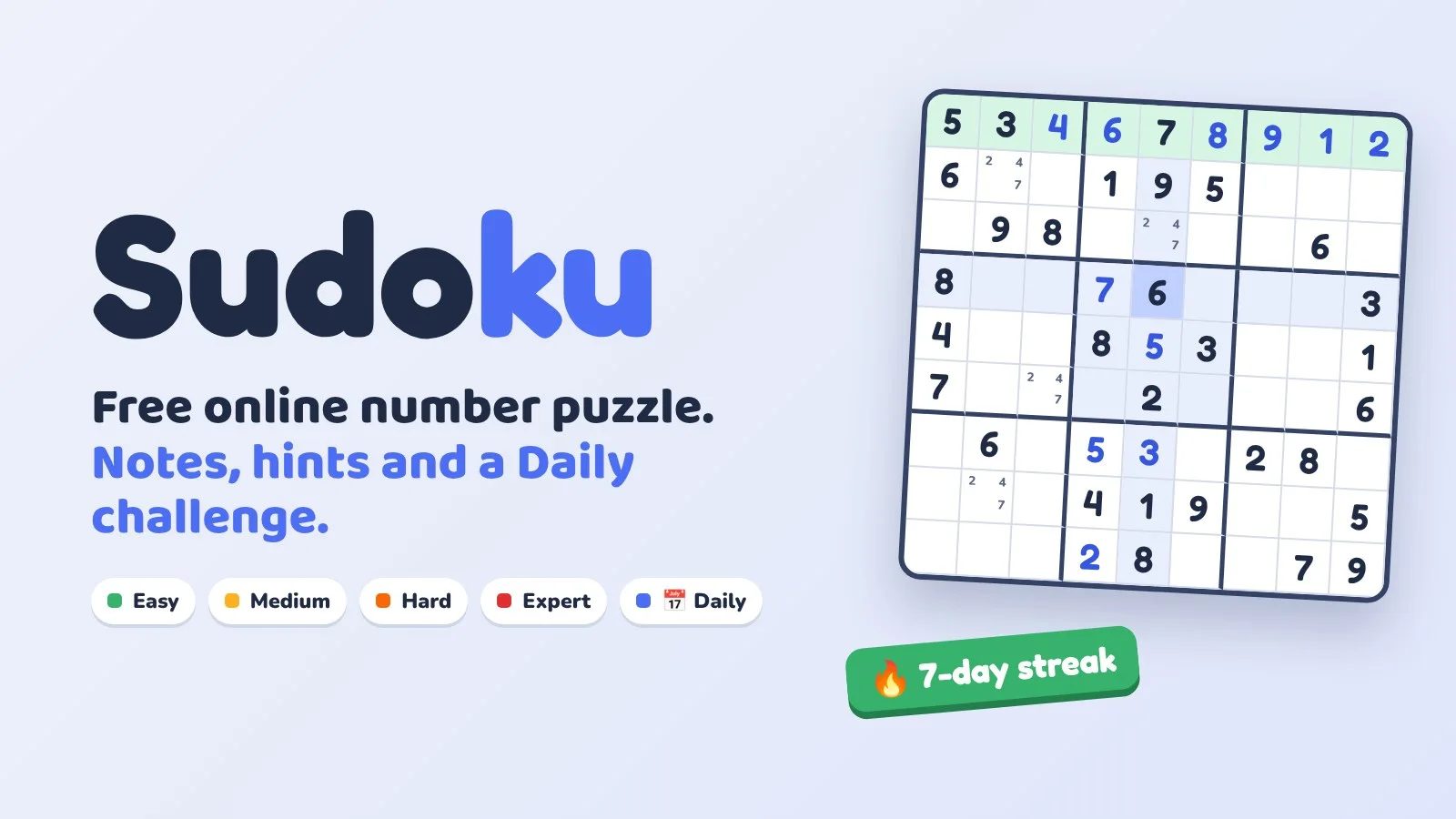
Sudoku looks like a maths puzzle, but you don't need to add or multiply anything. The numbers are just symbols. All you need is logic and a little patience. Every proper Sudoku has exactly one solution, and you can always reach it without guessing.
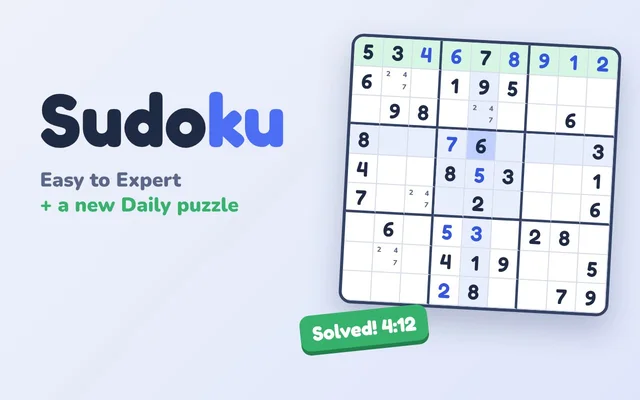
This guide covers the rules and seven techniques that are enough to solve any Easy puzzle. Try each one as you read on our free Sudoku game.
When we built our Sudoku, we graded every puzzle by the techniques it needs, not just by how many numbers are given at the start. That's why the techniques below map neatly onto the levels: the first five solve every Easy puzzle, and Medium starts asking for pencil marks.
The rules
A Sudoku grid has 9 rows, 9 columns and nine 3×3 boxes. Some squares already have numbers. Your job is to fill the rest so that:
- every row contains the numbers 1 to 9 exactly once;
- every column contains the numbers 1 to 9 exactly once;
- every 3×3 box contains the numbers 1 to 9 exactly once.
That's all. Every technique below comes from those three rules.
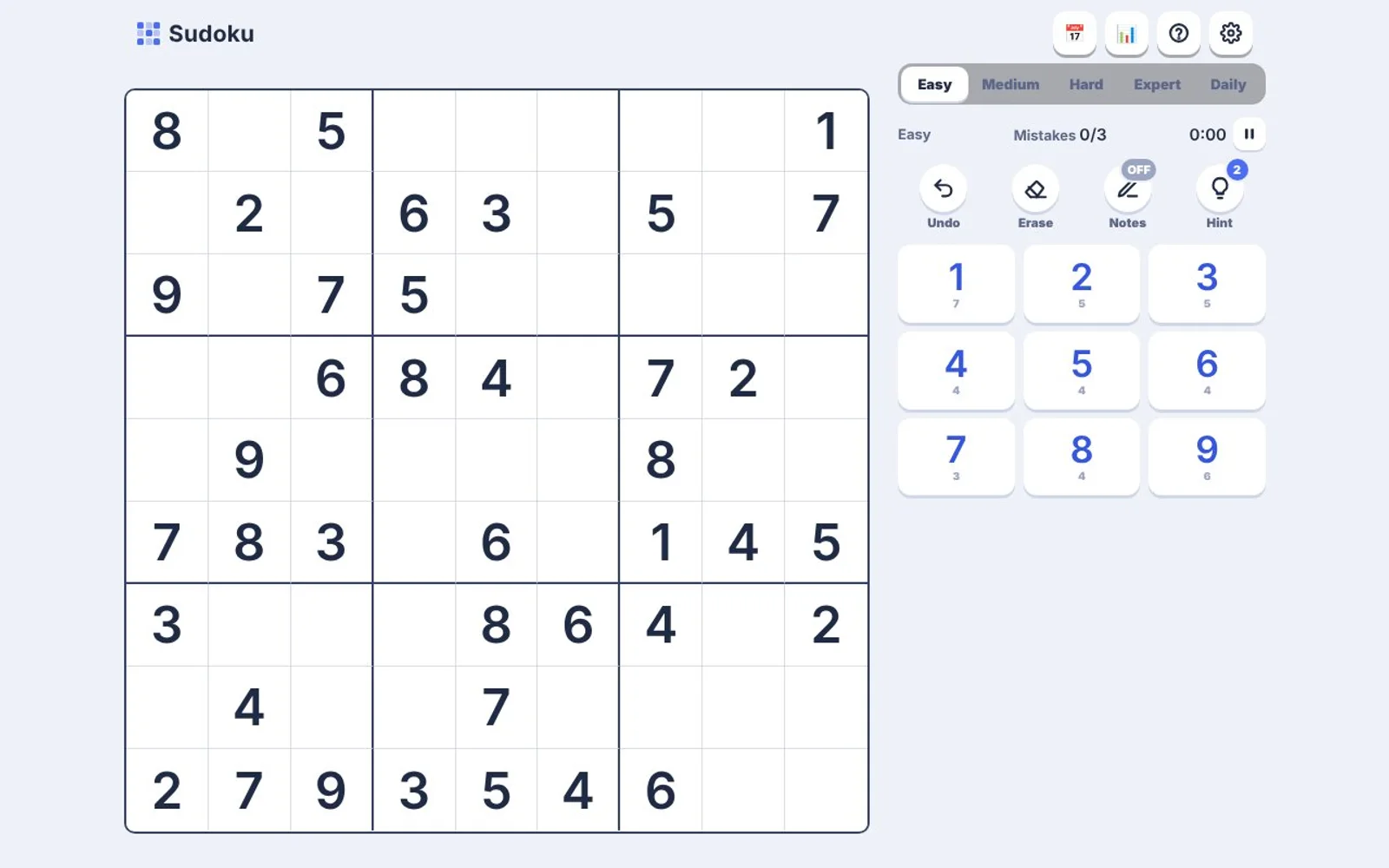
1. Scan one number at a time
Pick a number, say 5, and look at every 5 already on the grid. Each 5 rules out its row, its column and its box for any other 5.
Now look at a box that doesn't have a 5 yet. If only one empty square in that box isn't ruled out, the 5 must go there. This is called cross-hatching, and on Easy puzzles it alone fills in a lot of squares.
Tip: start with the number that already appears most often on the grid. It has the fewest places left to go.
2. Look for the last empty square
If a row, column or box has only one empty square, the missing number is obvious: it's whichever of 1 to 9 isn't there yet. Beginners often miss these because they look complicated at first glance. Check for them after every few moves.
3. Find the only number a square can be
Pick an empty square and ask: which numbers can't go here? Look along its row, its column and its box, and rule out everything you see. If only one number is left, that's the answer. This is called a naked single.
It works best on squares in busy areas of the grid, where the row, column and box are already mostly full.
4. Find the only square a number can go
This is the flip side of technique 3. Take one row, column or box, pick a number it's missing, and check each empty square in it. If the number can only go in one of them, put it there. This is called a hidden single, because the square might look like it has several options until you check that specific number.
5. Work where the grid is fullest
The more numbers a row, column or box already has, the fewer possibilities remain, so placements come quickly. When you're stuck, look for the fullest box or line and focus there. Each number you place makes its neighbours easier.
6. Use pencil marks
On harder puzzles, you'll reach a point where no square has a single obvious answer. That's when pencil marks help. Write the small candidate numbers each square could still be.
In our game, tap ✏️ Notes to switch to pencil marks. Notes are cleared automatically when you place a number nearby, so they never go out of date.
With notes in place, look for:
- squares with only one candidate left (a naked single you couldn't see before);
- numbers that appear as a candidate only once in a row, column or box (a hidden single).
7. Spot pairs
When two squares in the same row, column or box both have exactly the same two candidates, for example both show only 3 and 8, those two numbers must go in those two squares, in some order. That means 3 and 8 can't go anywhere else in that row, column or box. Remove them from the other squares' notes, and new singles often appear.
This naked pair technique is the step from Easy to Medium puzzles.
Habits that make solving easier
- Never guess. If you're unsure, leave the square empty. A wrong number early on causes many more mistakes later.
- Go round in circles. Use technique 1 for every number from 1 to 9, then techniques 2 to 4, then start again. Each pass usually unlocks a few more squares.
- Take a break. Fresh eyes spot things you missed. Our game pauses the timer when you leave and saves your puzzle automatically.
- Use hints sparingly. You get a few free hints in every puzzle. Try one more scan before using one.
How our Sudoku game helps you learn
Sudoku on Tikogames has four levels, from Easy to Expert, plus a Daily Sudoku that's the same for every player, with a calendar for the days you missed and a streak for solving on consecutive days.
While you play:
- highlights show the row, column, box and every matching number of the square you pick, which makes scanning much faster;
- wrong numbers turn red and count as a mistake (3 mistakes ends the game, or you can turn the limit off in Settings);
- your stats track best times, win rate and perfect games for each level.
Start with a few Easy puzzles, try technique 7 on a Medium one, and you'll be surprised how quickly the hard levels start to make sense.